

EU & EFSA MARKET ACCESS
The European Union regulates food supplements under a single body of law, then leaves the decisions that determine whether your product can be sold — botanicals, maximum levels, notification — to individual member states.
EU & EFSA MARKET ACCESS
The European Union regulates food supplements under a single body of law, and then leaves the parts that decide whether your product can actually be sold to individual member states. Maximum vitamin levels are national. Botanical acceptability is national. Notification is national. A product that is entirely legal in the Netherlands can be a medicine in Denmark and unsellable in France. Kompete maps that before you commit to a formula, a label or a distributor.

THREE LAYERS OF OVERSIGHT
Nobody has the whole picture, including the regulators.
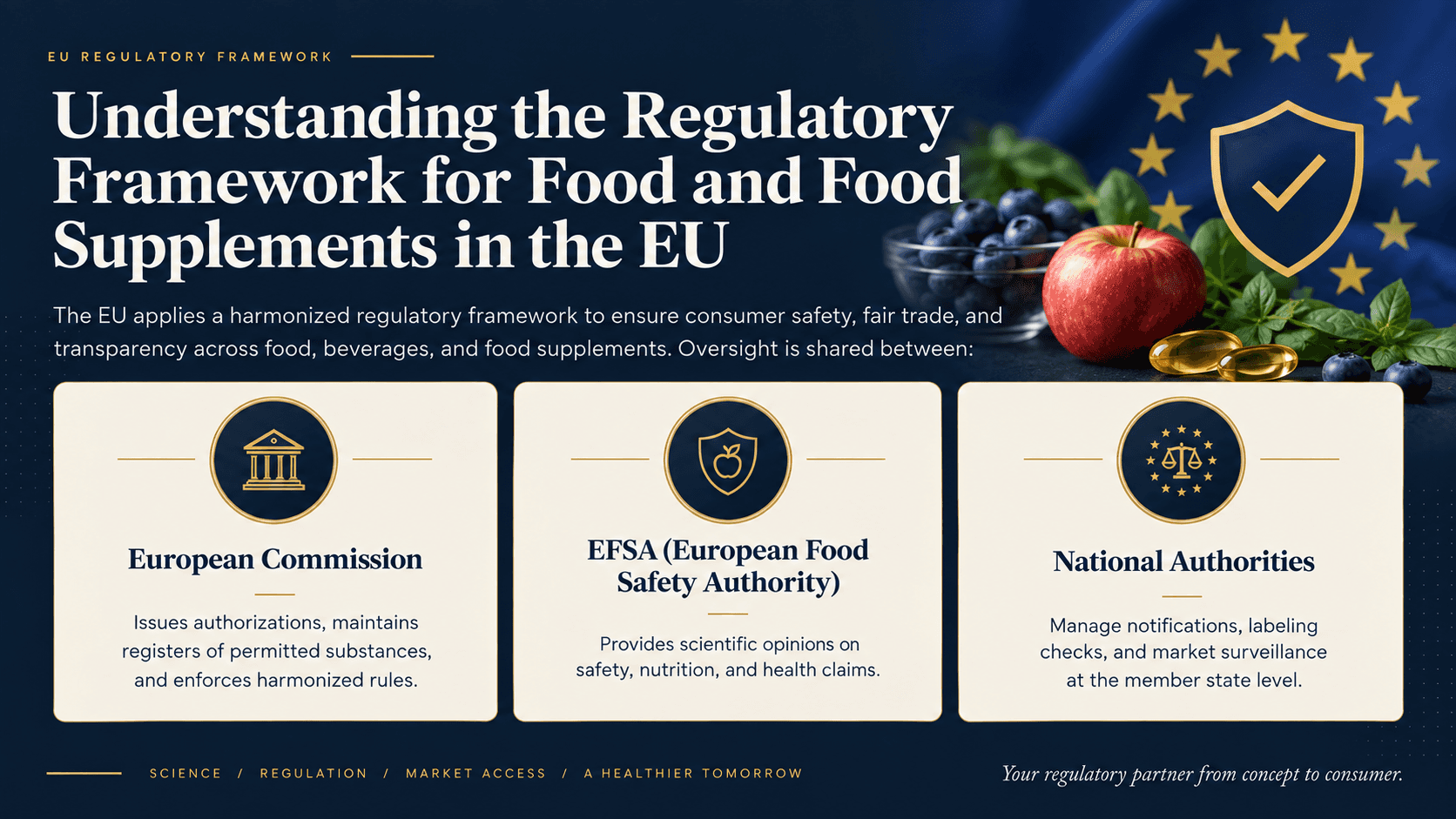
The practical consequence is that there is no single authority to apply to and no single approval to obtain. The Commission authorises substances and maintains registers. EFSA provides scientific opinions but does not grant market access. Member states run notification, check labels and conduct surveillance, and they do not agree with one another. Understanding which layer governs which part of your product is the difference between a market entry plan and a series of expensive surprises.
MEMBER STATE REALITY
Choose your first member state deliberately.
Notification requirements, botanical positions, and maximum vitamin and mineral levels differ across the union, so the country you launch in shapes the label you can carry everywhere else. We pick an entry state that keeps your formula intact and your artwork reusable, rather than the one your distributor happens to be in.

WHAT YOU ACTUALLY HAVE
The category determines the law.
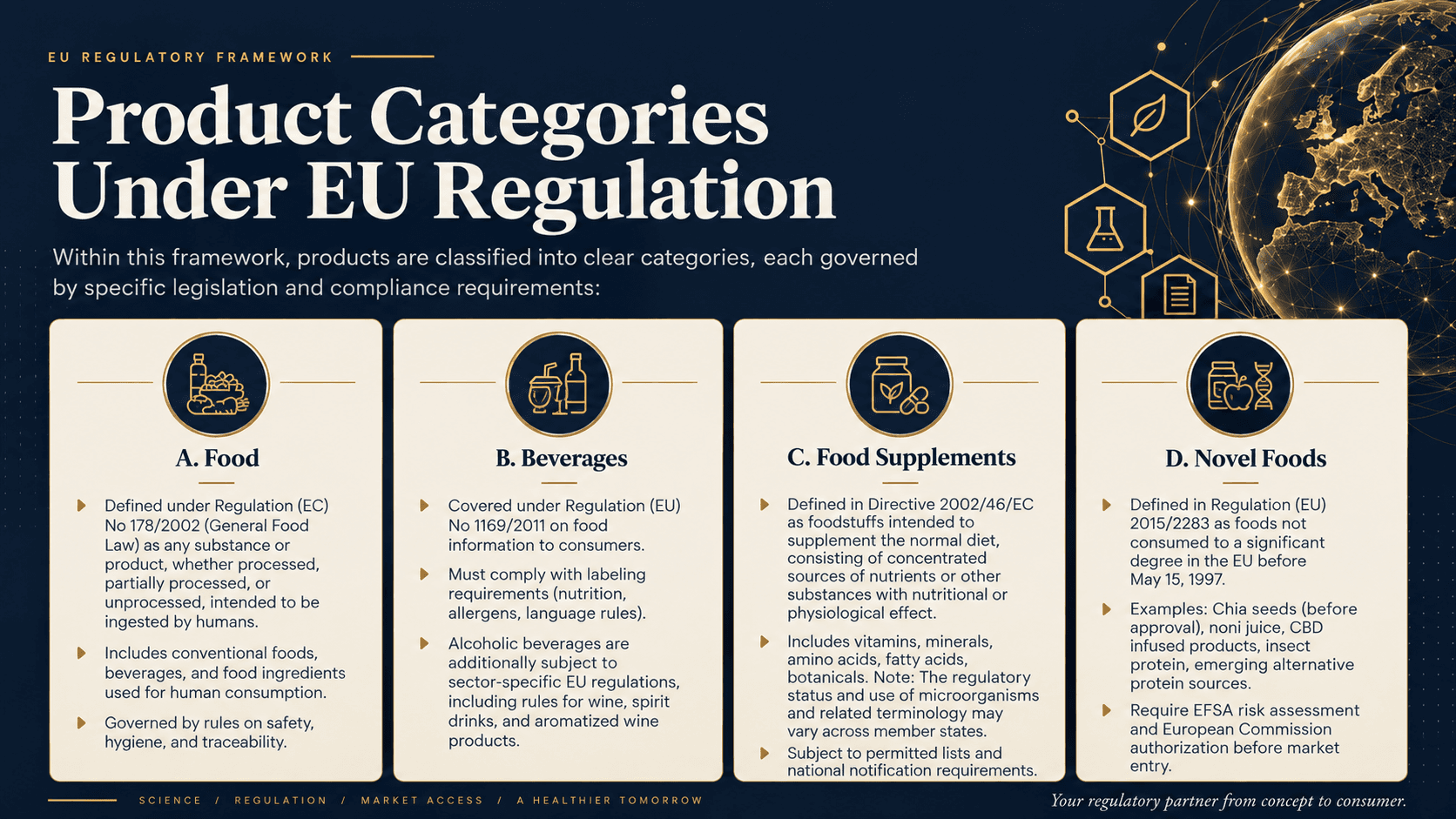
Classification is the first decision and the one that constrains everything after it. A food supplement, a fortified food, a novel food and a medicinal product are governed by different legislation with different evidence requirements and different routes to market. The same botanical extract can sit in more than one of these categories depending on dose, presentation and claim, and in more than one member state at the same time.
PILLAR 01
Classification and pathway
Before an application exists there is a question of what the product is, and the answer differs by market.
Assessment against the food supplement definition in Directive 2002/46/EC
Borderline determination between food supplement, fortified food and medicinal product
Novel food status assessment against the 15 May 1997 consumption cutoff
Member state by member state classification where national positions diverge
Medicinal by function and medicinal by presentation analysis
Category strategy where a formulation or claim change would avoid a harder pathway
PILLAR 02
Composition and permitted substances
Harmonisation covers less than most brands assume, and the gaps are where products fail.
Vitamin and mineral forms checked against the Annex II permitted list
Maximum permitted levels assessed market by market, since these are not harmonised
Botanical acceptability assessed against national positive and negative lists
Other substances including amino acids, enzymes and probiotics, where national rules govern
Contaminant and additive compliance under the applicable regulations
Reformulation strategy where a single ingredient blocks priority markets
PILLAR 03
Claims and substantiation
The claims regulation is the strictest part of the EU framework and the least forgiving of imported marketing copy.
Claim selection from the EU Register of authorised nutrition and health claims
Authorised wording applied correctly, including conditions of use and required accompanying statements
Article 13.5 applications where proprietary data supports a new function claim
Article 14 applications for disease risk reduction and children’s development claims
On-hold botanical claim risk assessment following the 2025 CJEU ruling
General wellbeing statement compliance, which must be accompanied by an authorised specific claim
PILLAR 04
Labelling and notification
Every market wants the same information in its own language, and several want to be told before you sell.
Food information compliance under Regulation 1169/2011
Mandatory particulars, allergen emphasis, nutrition declaration and legibility requirements
Supplement specific labelling including portion, warning and storage statements
Translation into each required national language, with regulated terminology verified
Notification dossiers for member states that operate a notification regime
Responsible food business operator established in the EU, identified on pack
NOVEL FOODS
If it was not eaten in Europe before May 1997, it is novel.
Regulation (EU) 2015/2283 defines a novel food as one not used for human consumption to a significant degree within the Union before 15 May 1997. That single date decides whether an ingredient can be sold freely or requires Commission authorisation and inclusion in the Union List. Novel status is not intuitive. Ingredients with long histories elsewhere in the world are routinely novel in Europe, and the burden of demonstrating pre-1997 consumption sits with you.
There are two routes. A full novel food authorisation requires a complete safety dossier, an EFSA risk assessment and a Commission implementing act, and realistically takes two years or more. Where an ingredient has a documented history of safe use in a non-EU country, the traditional food notification route is substantially faster.

The traditional food route depends on demonstrating at least 25 years of continuous safe use as part of the customary diet in a significant number of people in at least one non-EU country. Where that evidence exists, it is the difference between a notification measured in months and an authorisation measured in years.
THE CLAIMS REGULATION
You may only say what has already been approved.
Regulation 1924/2006 permits only claims that appear in the EU Register, used in wording that carries the same meaning as the authorised entry, subject to the conditions of use attached to it. A claim absent from the register cannot be used, regardless of the evidence behind it, until an application has been made and granted. This catches most brands entering from North America, where structure function claims are self-substantiated rather than pre-approved.
ARTICLE 13.1
General function claims based on generally accepted scientific evidence. Already in the register. Use the authorised wording and meet the conditions, including the minimum quantity that must be present per serving.
ARTICLE 13.5
New function claims based on newly developed scientific evidence, including proprietary data. Grants five years of data protection to the applicant, which makes it commercially interesting for branded ingredients.
ARTICLE 14
Disease risk reduction claims and claims relating to children’s development and health. The highest evidentiary bar, assessed individually by EFSA.
GENERAL WELLBEING
Non-specific references to overall health or wellbeing are permitted only when accompanied by a specific authorised claim from the register. A wellness statement standing alone is non-compliant.
THE UNRESOLVED QUESTION
Botanicals are where the harmonised framework stops.
Botanical health claims have been suspended since 2010. Roughly 1,500 to 2,000 claims sit on the on-hold list, neither authorised nor rejected, and industry has treated that list as a permissive space for over a decade. In April 2025 the Court of Justice of the European Union ruled in case C-386/23 that on-hold botanical claims may only be used where they comply with the requirements of the Claims Regulation and its Article 28 transitional provisions. That is a narrower position than the one many brands have been operating under, and it makes on-hold claim use a risk assessment rather than a default.
Ingredient acceptability is equally unsettled. Because botanical classification is not harmonised, a plant substance can be a food in one member state and a medicine in another. Ashwagandha is restricted in Denmark and freely sold in Germany and Sweden. Several member states maintain their own positive or negative lists. Building a European launch around a botanical without checking it market by market is the most common single cause of a supplement being pulled from one country while selling normally in the rest.
PRACTICAL REFERENCE
What harmonisation does not cover.
These are the areas where EU law leaves the decision to member states, and where a single European strategy fails.
Harmonised
Not harmonised
Not harmonised
Largely national
National
Harmonised
AFTER BREXIT
Great Britain is now a separate submission.
Great Britain operates its own regulatory regime, with its own novel food register and its own authorisation process administered by the Food Standards Agency. An EU novel food authorisation does not carry across, and a GB authorisation does not confer EU access. Northern Ireland continues to follow EU rules under the Windsor Framework, which means a product can require two dossiers to be sold across the United Kingdom. Brands still treating the UK as part of a European launch are usually working from a plan written before 2021.
ENGAGEMENT MODEL
Four steps to a European launch that holds.
01
Classify.
We determine the category in each target market, assess novel food status against the 1997 cutoff, and identify where a borderline call could go against you.
02
Map.
We check the formula against permitted substances, national maximum levels and botanical positions market by market, and tell you which countries the product can enter as designed.
03
Build.
We select and apply authorised claims, prepare compliant multilingual labelling, and assemble notification dossiers for the markets that require them.
04
Sustain.
We handle novel food and Article 13.5 applications, monitor national list changes, and maintain compliance as the framework moves.
Find out which European markets your product can actually enter.
Whether you are planning a first European launch, holding an ingredient you suspect is novel, or trying to understand why one member state pulled a product the rest are selling, the starting point is a market by market read of the formula and the claims.