
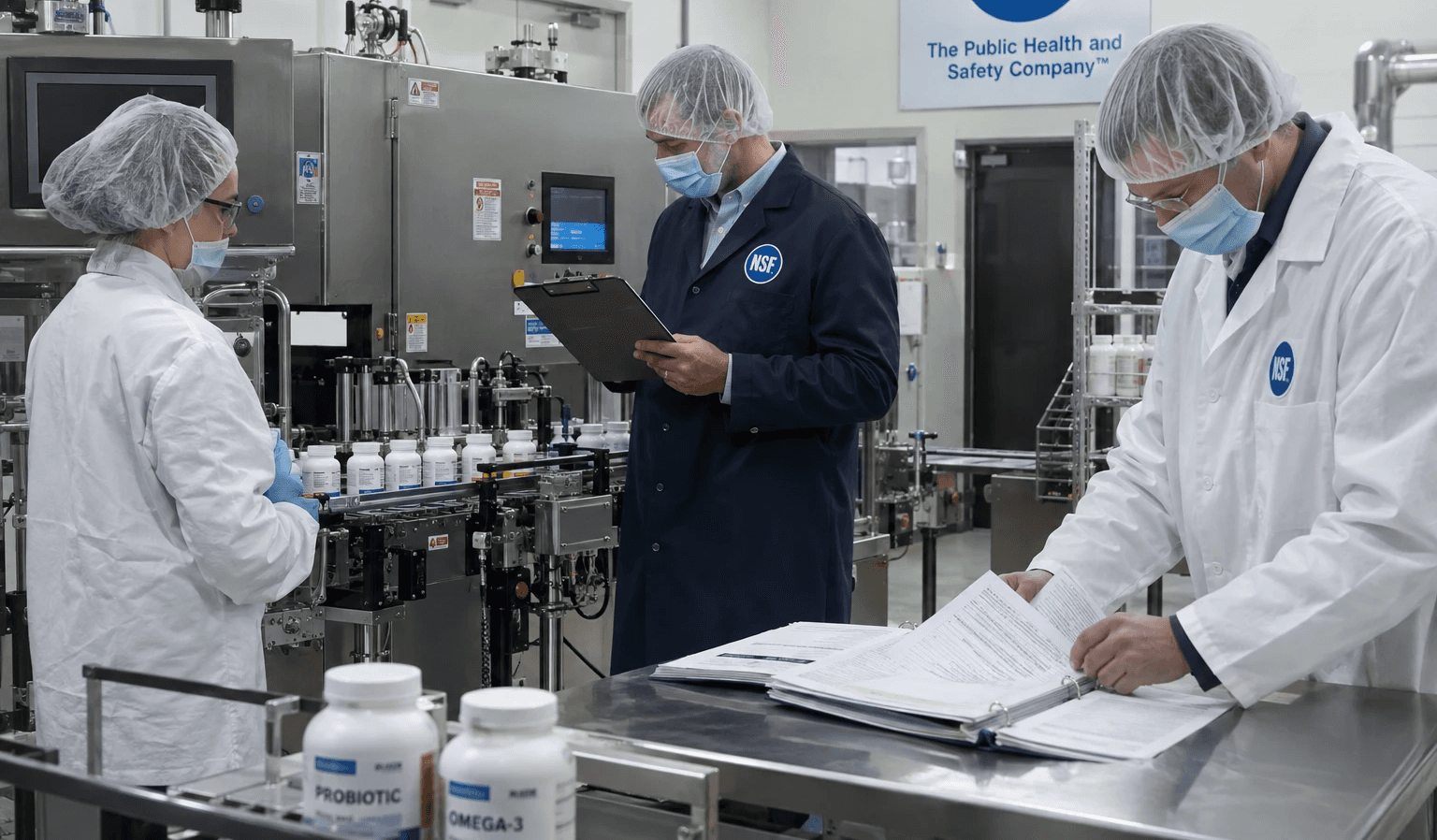
WHY CERTIFICATION SELLS
The number that explains the whole category.
In a 2024 survey of 1,000 US adults conducted by Opinium Research for NSF, 83 percent said they read food labels before making a purchase decision, and 64 percent said they pay more attention to labels than they did five years ago. Only 16 percent said they find health claims on food packaging very trustworthy.
83%
read labels before buying
16%
find health claims very trustworthy
78%
read the health claims specifically
55%
would pay more for transparent labeling
That is the commercial case for certification stated plainly. Attention is not the problem. Belief is. A claim that a brand makes about itself competes with every other brand making the same claim, and consumers have priced that in. A mark that requires an independent laboratory to test the product and an auditor to inspect the plant is one of the few remaining ways to say something a competitor cannot simply copy onto their own panel. Source: NSF consumer research, conducted by Opinium Research, October 2024, 1,000 US adults, weighted to be nationally representative.
WHAT NSF ACTUALLY OFFERS
Three programs, and only two put a mark on your package.
NSF operates several distinct programs that get discussed as though they were one thing. They certify different objects, require different work, and grant different rights.
FACILITY
GMP registration and certification. Assesses the plant, not the product. An auditor examines your quality system, your procedures, your equipment, your records and your people, and determines whether the facility operates to the standard. NSF/ANSI 455-2 for dietary supplement manufacturers and packagers. NSF/ANSI 455-3 for cosmetics. NSF/ANSI 455-4 for over the counter drugs. Covers manufacturers, packagers, warehousing and distribution. Developed with industry, regulators, retailers and consumer groups. Accredited by the ANSI National Accreditation Board.
PRODUCT
NSF/ANSI 173 and NSF 527. Assesses the finished product. Laboratory testing confirms that what the panel declares is what the container holds, and that nothing else of consequence is present. NSF/ANSI 173 is the American National Standard for dietary supplements. NSF 527 covers personal care and cosmetic products. Label claim verification against actual composition. Toxicological review of every intentionally added ingredient. Contaminant screening across chemical and microbiological panels. Annual facility audits and periodic retesting of certified products.
SPORT
Certified for Sport. Adds banned substance screening on top of product certification. Built for athletes under anti-doping jurisdiction, where a contaminated supplement ends a career rather than a sale. Requires prior certification to NSF/ANSI 173, NSF 229 or NSF 527. Screening for hundreds of substances banned by major sporting bodies. Recognised by USADA, MLB, the NHL and the CFL. Recommended by the NFL, NBA, PGA, LPGA, UFC, CCES, Ironman and others. Lot level testing rather than a single qualifying sample. Required for listing by many teams, leagues and specialist retailers.
WHAT YOU MAY PRINT
A registered facility does not earn you a logo.
This is the most common and most expensive misunderstanding in the category. GMP registration certifies the plant. It does not certify anything you make in it, and it does not entitle you to place a certification mark on your packaging. Only product certification does that, and it certifies a specific product, made to a specific formula, at a specific site.
PRODUCT SPECIFIC
The mark applies to the certified product, not to your brand, your range or your company. Every SKU requiring the mark requires its own certification.
FORMULA LOCKED
A change to the formula, the supplier of a medicinal ingredient, the dosage form or the manufacturing site can invalidate the certification until it is reassessed.
ARTWORK APPROVAL
Mark placement, size, proportion and accompanying text are governed by the licence agreement. Artwork is submitted and approved before print, not after.
NO IMPLIED ENDORSEMENT
Certification confirms conformance to a standard. Marketing that presents it as an endorsement of efficacy, or that implies certification of an uncertified product in the same range, is a licence breach.
CLASS III
210 days
Outside monograph parameters
Any product with an absent ingredient, an unlisted range, an uncovered claim or a novel delivery format. The file needs a full safety and efficacy dossier at the actual dose, plus novel ingredient, manufacturing, stability and population rationale.
Brands routinely print a mark earned on one product across a whole line. It is the fastest way to lose the certification and the retailer relationship that depended on it.
WHAT GETS TESTED
The panel behind the mark.
Product certification is a laboratory exercise before it is a paperwork exercise. These are the areas assessed. Label claim verification: every declared ingredient identified and quantified against the panel, confirming the supplement facts panel reflects actual contents. Toxic elements: lead, mercury, arsenic, cadmium and hexavalent chromium. Microbiological: aerobic plate count, yeast and mould, Enterobacteriaceae, Salmonella, E. coli and Staphylococcus aureus. Mycotoxins: hepatotoxic compounds produced by fungal contamination. Pesticides: residue panels applied to products containing botanical material. Undeclared substances: screening for ingredients not on the label, including pharmaceutical adulterants.
CERTIFIED FOR SPORT
What gets a product rejected.
The Certified for Sport screening panel covers hundreds of substances across every class prohibited by major sporting organisations, and the list is revised as new compounds appear. The classes assessed include anabolic steroids and prohormones, selective androgen receptor modulators, stimulants, beta-2 agonists, diuretics and masking agents, growth hormone releasing agents and peptides, hormone and metabolic modulators, and narcotics.
Where failures originate
Shared manufacturing equipment with inadequate cleaning validation between runs. Raw materials from suppliers whose own upstream chain is unverified. Botanical extracts containing naturally occurring compounds on prohibited lists. Proprietary blends where the actual composition is not fully disclosed to the manufacturer. Flavour and colour systems sourced without regulatory review. Contract manufacturers running unrelated products with prohibited actives in the same facility.
HOW STRICT IS IT
Above the regulatory floor, by design.
21 CFR Part 111 sets the minimum lawful standard for dietary supplement manufacturing in the United States. The NSF/ANSI 455 standards were developed to sit above it, combining regulatory requirements with retailer quality expectations and industry best practice. The practical difference is not that the topics change. It is that the evidence expected for each of them is more demanding. Documented and validated procedures rather than procedures that exist on paper. Training records that demonstrate competence, not attendance. Equipment qualification and cleaning validation with supporting data. Supplier qualification programs with evidence of ongoing verification. Specification systems with justified acceptance criteria and named methods. Deviation and complaint investigation with documented root cause analysis. Retain sample and stability programs operating as designed rather than as described. Change control with assessed impact rather than retrospective notification. For most facilities the gap is not competence. It is that the practice is sound and the documentation does not prove it. An auditor can only assess what is recorded.

THE REGISTRATION PROCESS, STEP BY STEP.
WHAT KOMPETE DOES
Everything before the auditor arrives.

Certification bodies audit. They do not prepare you for the audit, and they do not fix what they find. That work sits with you, and it is where most of the cost and delay of certification actually lives.
GAP ASSESSMENT
A structured review of your current quality system against the applicable standard, identifying every finding an auditor would raise before one does, with each gap ranked by severity and effort.
DOCUMENTATION BUILD
Standard operating procedures, master manufacturing records, batch records, specifications, validation protocols and training materials written to the standard and to how your operation actually runs.
PRODUCT PREPARATION
Formula review against the certification requirements, supplier and certificate of analysis assessment, and coordination of the pre-submission testing that determines whether a product will pass.
APPLICATION MANAGEMENT
Preparation and submission of the application file, management of the certification body relationship, and coordination of the audit itself.
CORRECTIVE ACTION
Response to audit findings, including root cause analysis, corrective action plans and the evidence packages required to close each finding and reach registration.
ENGAGEMENT MODEL
Four steps to a mark you can defend.
01 Scope
We determine which program fits the commercial objective, since facility registration, product certification and sport certification solve different problems at very different costs.
02 Assess
We audit against the standard before the certification body does, and produce a ranked list of what has to change.
03 Prepare. We build the documentation, run the pre-submission testing, and close the gaps that would otherwise become findings. 04 Certify. We manage the application, the audit and the corrective action cycle through to registration, and maintain it through subsequent monitoring audits.
The audit is the easy part. The preparation is not.
Whether you are pursuing certification for a retailer requirement, preparing a facility for its first audit, or holding findings you have not been able to close, the starting point is an honest assessment of the distance between where you are and what the standard expects.