

HEALTH CANADA & NPN LICENSING
Every natural health product sold in Canada needs a product licence before it reaches a shelf, a warehouse or an Amazon listing. No NPN means no legal sale, no retail listing and no inventory in the country. Kompete has prepared well over 100 successful applications across Class I, Class II and Class III, along with medical device licensing and cosmetic notifications, and knows where files stall before they are filed.

WHAT WE HAVE FILED
Application experience is not transferable in the abstract. A Class I monograph submission and a Class III novel ingredient file are different pieces of work with different failure modes. Kompete has prepared and defended files across the full range, including products that started as Class III and were restructured into Class II to shorten the review by four months.
100+
NPN applications
Prepared across Class I, II and III, including reformulations to change class.
3
Licence classes
Full experience across monograph, multi-monograph and non-monograph submissions.
Devices
Medical device licensing
Class I through Class III device applications and establishment licensing.
Cosmetics
Notification filings
Cosmetic Notification Forms for makeup, skincare, lotions and topical products.
KNOW WHAT YOU HAVE
Before an application exists there is a classification question, and getting it wrong costs months. A skincare product making a therapeutic claim is not a cosmetic. A topical with an active drug ingredient is not an NHP. The same formula can sit in three different regulatory streams depending on what the label says.
NATURAL HEALTH PRODUCTS
Vitamins, minerals, herbals, probiotics, amino acids, essential fatty acids and traditional medicines. Requires a product licence and NPN before sale, plus a site licence for the Canadian facility.
COSMETICS
Makeup, skincare, lotions, cleansers and personal care products without therapeutic claims. Requires a Cosmetic Notification Form filed within ten days of first sale, not an NPN.
MEDICAL DEVICES
Class I through Class IV. Class II and above require a Medical Device Licence. Importers and distributors require a Medical Device Establishment Licence.
NON-PRESCRIPTION DRUGS
Products with active ingredients outside the NHP framework require a Drug Identification Number under a different submission pathway with different evidence expectations.

EVIDENCE & CLASS
Your class is decided by your claim.
A monograph-aligned formula with pre-cleared wording moves quickly. Step outside the monograph, or ask for a claim it does not carry, and the application becomes a full evidence review with a materially longer timeline. Choosing between speed and differentiation is a commercial decision, so we put both options in front of you with real dates attached.
CLASS I, II AND III
Health Canada assigns a class based on how closely the product matches existing monographs. The class determines the review target, the evidence you must supply, and how much room there is for anything to go wrong.
CLASS I
60 days
Single monograph
A product whose medicinal ingredient, dose, claim and directions all fall within one Health Canada monograph. The file matches the monograph line by line, including source material, dose range, claims, specification, certificates of analysis, site licence details and bilingual label text.
CLASS II
90 days
Multiple monographs
Two or more medicinal ingredients, each covered by its own monograph, combined within their respective parameters. The full ingredient set needs claim consistency, interaction review, combined specification, supplier documents and reconciled risk statements.
CLASS III
210 days
Outside monograph parameters
Any product with an absent ingredient, an unlisted range, an uncovered claim or a novel delivery format. The file needs a full safety and efficacy dossier at the actual dose, plus novel ingredient, manufacturing, stability and population rationale.
These are service standards, not guarantees. An incomplete file is returned, and the clock restarts. Missing safety data on a Class III submission can extend the timeline well beyond 210 days.
WHEN THERE IS NO MONOGRAPH
The evidence bar rises sharply.
An ingredient with no monograph and no established history of use in Canada requires you to build the safety case from the ground up. Health Canada assesses the exact material, manufacturing process, toxicological profile, human safety evidence and exposure from all sources. Each claim needs evidence at the dose in your product. A study run at 900 mg does not substantiate a claim at 200 mg, and this is the most common reason Class III files come back.
LABEL COMPLIANCE
Label text is submitted with the application and assessed as part of it. A label that does not match the approved licence is a compliance problem regardless of whether the product itself is correct.
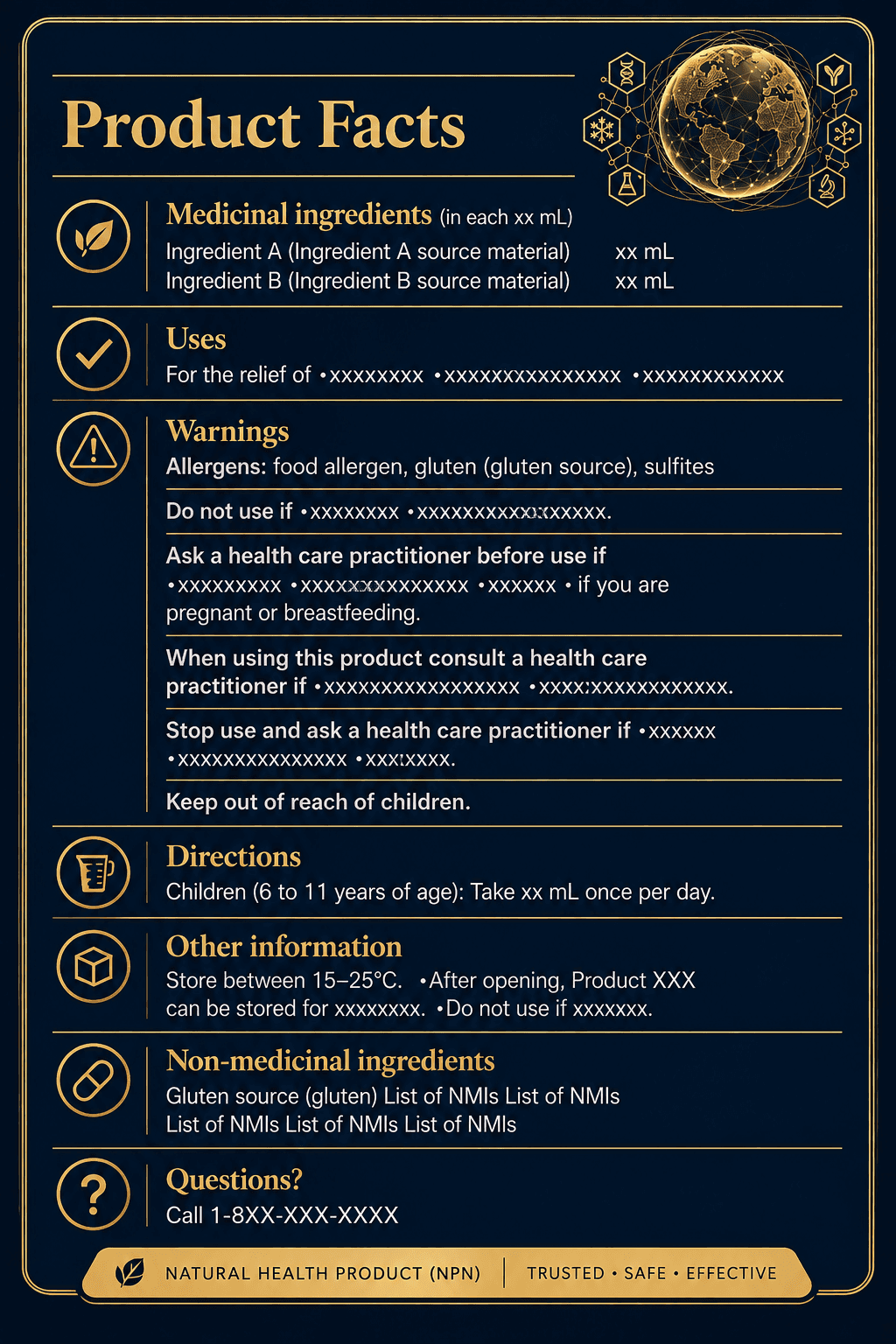
What the label must carry
– Product name and the licence holder’s name and address
– The NPN on the principal display panel
– Medicinal ingredients, source material and quantity per dosage unit
– Complete non-medicinal ingredient list
– Approved use, recommended dose, route and duration
– Risk information, storage conditions, lot number and expiry date
– Every element in both English and French
ENGLISH AND FRENCH
Both languages, equal prominence.
Bilingual labelling is not a translation exercise added at the end. Every mandatory element appears in both official languages, at equivalent prominence, and the French must reflect the approved claim rather than a literal rendering of the English. Space is the practical constraint, and it needs solving before artwork is finalised.
WHAT IS CHANGING
The Product Facts table, and a moving deadline.
Amendments to the Natural Health Products Regulations came into force on June 21, 2025, introducing a standardized bilingual Product Facts table, revised allergen labelling, minimum type size, sans-serif type and high contrast requirements. A Ministerial Exemption Order aligned every NHP in Canada to a single compliance date of June 22, 2028.
That date is now less certain than it appears. Health Canada has committed to further amendments, with draft regulations targeted for spring 2027 and a new transition period expected beyond June 2028. Packaging still has to change, but artwork investment should be staged rather than committed in full.
AT THE BORDER

Documentation required for every commercial shipment
– NPN or DIN-HM referenced on the shipment or included as a copy
– Product licence confirmation
– Site licence number for the receiving facility
– Commercial invoice with accurate HS classification
– Evidence of bilingual labelling compliance
CBSA coordinates with Health Canada on admissibility. Repeated documentation errors move a shipper into more frequent inspection, which turns a one-time problem into an ongoing cost.
TWO DIFFERENT ROUTES
Health Canada permits individuals to import natural health products for personal use without an NPN, within specific limits. For a US brand testing Canadian demand, this can work as a short term direct to consumer route while an application is in review. It is not a market entry strategy.
Personal use import
– Maximum 90 day supply per shipment
– Must ship directly to the individual consumer
– Cannot ship to a warehouse or fulfilment centre
– Cannot contain ingredients on the prescription drug list
– No bulk quantities
Commercial import
– A valid NPN for every product SKU
– A site licence for the Canadian facility handling the product
– Bilingual labelling on all packaging
– Full customs documentation on every shipment
– Required for Amazon.ca, Canadian retail and all wholesale
There is no workaround on the commercial side. Amazon.ca will not accept a supplement listing without a valid NPN, and Canadian retailers will not stock an unlicensed NHP.
BEYOND THE PRODUCT LICENCE
A product licence authorises the product. A site licence authorises the facility that manufactures, packages, labels or imports it. Both are required, and a valid NPN does not help if the site handling your product is unlicensed.
SITE LICENSING
Every Canadian facility that manufactures, packages, labels or imports the product needs a site licence, held against evidence of good manufacturing practices covering premises, equipment, personnel, sanitation, quality assurance, records and recall procedures.
FINISHED PRODUCT SPECIFICATION
A product-specific document defining identity, potency, purity, physical and microbial limits with justified acceptance criteria and named test methods. This is a core requirement and a frequent source of information requests.
TESTING REQUIREMENTS
Identity and potency of each medicinal ingredient, microbial limits, heavy metals, and where relevant disintegration, pesticide residues, solvent residues and oxidation markers. Stability data must support the shelf life on the label.
PUBLIC VERIFICATION
How a licence is verified
Every authorised natural health product appears in Health Canada’s Licensed Natural Health Products Database, searchable by product name, NPN or company. The entry shows the licence holder, approved medicinal ingredients and doses, approved claims and dosage form. Retail buyers, competitors and Health Canada check it.
This is why claims discipline matters. Your approved claim set is public, and marketing language that exceeds it is visible to anyone who compares your website against your licence.

BEYOND CANADA
The NPN process is among the more demanding pre-market frameworks in the world. Every ingredient is assessed, every claim reviewed, the manufacturing site licensed and the specification scrutinised before a unit is sold. Brands that treat the Canadian file as the foundation of their regulatory dossier reuse its specifications, stability data, claim substantiation and supplier qualification repeatedly.
ENGAGEMENT MODEL
01
Classify
We review the formula and intended claims, determine which class applies, and identify where a formulation adjustment can save four months.
02
Assemble
We build the specification, gather ingredient documentation, compile claim evidence and prepare bilingual label text.
03
Submit
We file the application and manage the review, including information requests answered from prepared material.
04
Maintain
We handle amendments, formula and supplier changes, label updates and the transition to new labelling requirements.
Whether you are filing a first application, sitting on a stalled file, moving a US product into Canada, or preparing for the labelling transition, the useful first step is a classification review of what you actually have.