

TGA & AUSTRALIAN MARKET ACCESS
Complementary medicines are regulated under the Therapeutic Goods Act, which changes the ingredients you may use, the words you may say, the manufacturing standard you must meet, and who is accountable when any of it is wrong.
TGA & AUSTRALIAN MARKET ACCESS
Products sold as dietary supplements in North America and as food supplements in Europe are regulated in Australia as complementary medicines under the Therapeutic Goods Act 1989. That single reclassification changes the ingredient list you are allowed to use, the words you are allowed to say, the manufacturing standard you must meet, and who can be held responsible when any of it is wrong. Kompete determines the correct pathway before the formula is locked.

A DIFFERENT CATEGORY ENTIRELY
Not a food. Not a supplement. A therapeutic good.
Most jurisdictions regulate supplements under food law, where the default assumption is that an ingredient is permitted unless restricted. Australia inverts that. A complementary medicine may contain only ingredients that appear on a published permitted list, and may carry only indications drawn from a published permitted list, in the exact wording specified. Anything outside those lists requires a different and considerably more demanding pathway. A product that does not meet the definition of a therapeutic good may instead fall under the Food Standards Australia New Zealand framework, which is a separate regime with its own requirements. Intended purpose, ingredients and claims together determine which applies, and that determination is the first piece of work, not a formality after the formula exists.

MANUFACTURING STANDARD
Food-grade manufacturing will not clear customs.
Because complementary medicines are therapeutic goods, they must be made at a site holding a recognised medicines manufacturing licence or an accepted overseas equivalent, with the sponsor holding the evidence. Contract manufacturers that serve the supplement trade elsewhere often cannot meet it, which is why we qualify the site before the formula is committed.
AUST L, AUST L(A) AND AUST R
Three tiers, and only one of them is reviewed the way you expect.
Every medicine in the Australian Register of Therapeutic Goods carries an identifier beginning with AUST, followed by L, L(A) or R. The letter tells you how much the TGA looked at before the product reached the shelf.
AUST L
Listed medicines
The lowest risk tier and the pathway most supplements use. There is no TGA pre-market assessment. The product enters the register once the sponsor certifies that every legislative requirement has been met. The certification is the regulatory act, and it carries the liability.
Ingredients restricted to the Permissible Ingredients Determination
Indications restricted to the Permissible Indications Determination, used in the exact wording published
Traditional indications must carry the traditional use qualifier
Manufactured under Good Manufacturing Practice at a licensed or cleared site
Sponsor holds evidence supporting every indication, available on request
Entry into the register is effectively immediate once the application is complete
AUST L(A)
Assessed listed medicines
The intermediate tier, introduced for products needing indications beyond the permitted list but not requiring full registration. Safety and quality remain self-certified. The TGA pre-market assesses the efficacy evidence supporting the indications, and only that.
Same permitted ingredient restrictions as AUST L
Indications may be higher level or more specific than the permitted list allows
Efficacy evidence submitted and evaluated before inclusion
Timelines measured in months rather than the immediacy of AUST L
Permits the assessed claim and the TGA assessed symbol on packaging
Safety and quality still self-certified, not evaluated
AUST R
Registered medicines
The fully evaluated tier. Quality, safety and efficacy are all assessed before the product may be supplied. Reserved for higher risk complementary medicines and products whose ingredients or claims cannot be accommodated in either listed pathway.
Full evaluation of quality, safety and efficacy
Required where ingredients fall outside the permitted determination
Required where claims relate to serious conditions
Substantially longer timelines and higher fees
Comprehensive manufacturing and quality documentation
The pathway a formulation decision can force you into without anyone intending it
WHAT AUST L(A) BUYS YOU
The only claim of assessment you are permitted to make.
An assessed listed medicine may state on its packaging that the evidence for its approved indications has been assessed by the TGA, and may display the TGA assessed symbol. This is the single circumstance in which an Australian complementary medicine may reference TGA assessment on pack, and it is a meaningful commercial differentiator in a category where every competitor carries an AUST L number that means nothing of the kind.

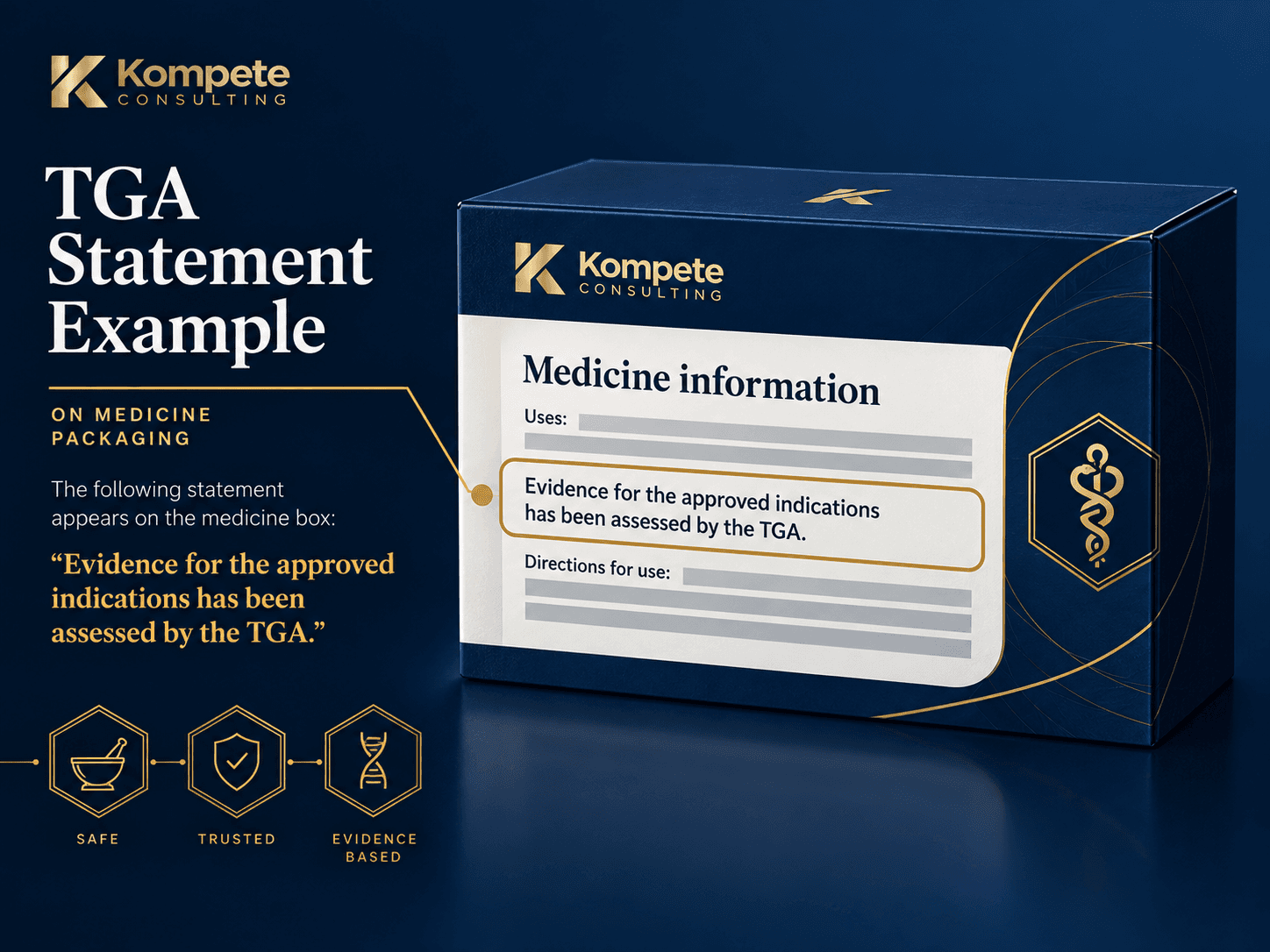
The symbol and the statement are only available through the AUST L(A) pathway. Whether the additional evidence work is worth it depends on how much of your positioning rests on the claim it unlocks.
PERMISSIBLE INGREDIENTS
A closed list that keeps moving.
The Therapeutic Goods Permissible Ingredients Determination specifies every ingredient that may be used in a listed medicine, together with maximum quantities, mandatory warning statements, restrictions on plant part and preparation, and conditions of use. It is a legislative instrument, updated periodically, and formulating against an outdated version is a common and expensive error.
CLOSED LIST
If an ingredient is not on the determination, it cannot be used in a listed medicine at any dose. There is no notification pathway and no self-affirmation equivalent.
QUANTITY LIMITS
Many permitted ingredients carry maximum daily quantities. Exceeding one moves the product out of the listed pathway entirely.
MANDATORY WARNINGS
Specific ingredients trigger specific warning statements in specified wording, which must appear on the label.
SCHEDULING
Ingredients must comply with the Standard for the Uniform Scheduling of Medicines and Poisons where applicable, which can restrict or prohibit a substance independently of the permitted list.
PERMISSIBLE INDICATIONS
You do not write your own claims.
Listed medicines may only carry indications drawn from the Permissible Indications Determination, and the specified wording must be used exactly. Paraphrasing a permitted indication is non-compliance. The list spans general health maintenance, vitamin and mineral function, Western herbal tradition, Traditional Chinese Medicine, Ayurveda, aromatherapy and homoeopathy, and traditional indications must be qualified to signal that the basis is traditional use rather than clinical evidence.
This constrains marketing more than most brands anticipate. Positioning built around a specific benefit statement in another market frequently has no permitted equivalent in Australia, and the choice becomes rewording the proposition, moving to AUST L(A), or abandoning the claim. Deciding that at formulation stage costs nothing. Deciding it after artwork is printed costs a great deal.
GMP
Where Australia is genuinely demanding.
Good Manufacturing Practice requirements apply to listed and registered medicines alike. An Australian manufacturing site requires a GMP licence. An overseas site requires GMP Clearance, granted on evidence that the site meets a standard the TGA accepts. This is not self-certified, it is not waived for low risk products, and it is where most first-time applicants discover their existing contract manufacturer cannot supply Australia at all.
GMP CLEARANCE
Overseas manufacturing sites require clearance before their product can be listed. Clearance is site and dosage form specific, takes time to obtain, and is a common cause of launch delay.
SITE QUALIFICATION
Assessment of whether your existing manufacturer holds appropriate certification, and identification of alternatives where it does not.
LIFECYCLE COMPLIANCE
GMP obligations continue after listing. A change of manufacturing site, process or dosage form has regulatory consequences that need assessing before the change is made.
AFTER THE LISTING
The review happens later, and it has teeth.
Because listed medicines are not evaluated before entry, the TGA conducts post-market review instead, examining several hundred products a year through both random and targeted programs. A review that finds insufficient evidence for an indication, incorrect labelling, an impermissible ingredient or a false certification can result in cancellation from the register. Cancelled products are published.
Advertising is separately regulated under the Therapeutic Goods Advertising Code, and one restriction catches almost every new entrant. You may not state or imply that inclusion in the register constitutes TGA recommendation, endorsement or approval. An AUST L number confirms compliance with legislative requirements. Marketing that presents it as government approval of the product is itself a breach, and the phrasing that achieves this is easy to write by accident.
WHAT THE WORK IS WORTH ELSEWHERE
Built for Australia, portable by design.
It is often said that Australian requirements are simply stricter than American or Canadian ones. That is not accurate as a general statement. Health Canada reviews an NPN application before issuing a licence, which is more pre-market scrutiny than an AUST L listing receives. What Australia demands is different in kind rather than uniformly greater in degree, and the parts it demands most are the parts that travel.
MANUFACTURING
A site holding TGA GMP licensing or clearance has met a standard recognised internationally. That qualification carries weight with Health Canada, with EU distributors and with retail buyers assessing a supply chain, and it is the single most transferable asset an Australian file produces.
FORMULATION DISCIPLINE
A formula built against a closed permitted ingredient list, with quantity limits and mandatory warnings already respected, tends to clear Canadian monograph review and European ingredient restrictions with fewer surprises. The constraint that felt punitive in Australia becomes a shortcut elsewhere.
CLAIM DISCIPLINE
A product whose claims survived the Permissible Indications framework, or an AUST L(A) efficacy assessment, arrives in other markets with its evidence already organised. That is most of the work in a Canadian claim substantiation file and an FTC-defensible position in the United States.
The useful framing is not that one regulator is harder. It is that the evidence, specifications and manufacturing qualifications assembled for one market should be built once and reused, rather than rebuilt from scratch in each.
ENGAGEMENT MODEL
Four steps to an ARTG listing.
01
Classify
We determine whether the product is a therapeutic good or a food, and which of the three pathways applies given the formula and the claims you intend to make.
02
Reconcile
We check every ingredient against the current Permissible Ingredients Determination and every claim against the Permissible Indications Determination, and identify what has to change.
03
Qualify
We assess whether your manufacturing site holds appropriate GMP licensing or clearance, and manage the process where it does not.
04
List
We prepare the certification file, the label and the evidence package, submit through the register, and maintain the listing through ingredient, claim and site changes.
Whether you are entering Australia for the first time, weighing whether an assessed listing is worth the additional evidence work, or holding a listing that a post-market review has questioned, the starting point is reconciling your formula and claims against the current determinations.